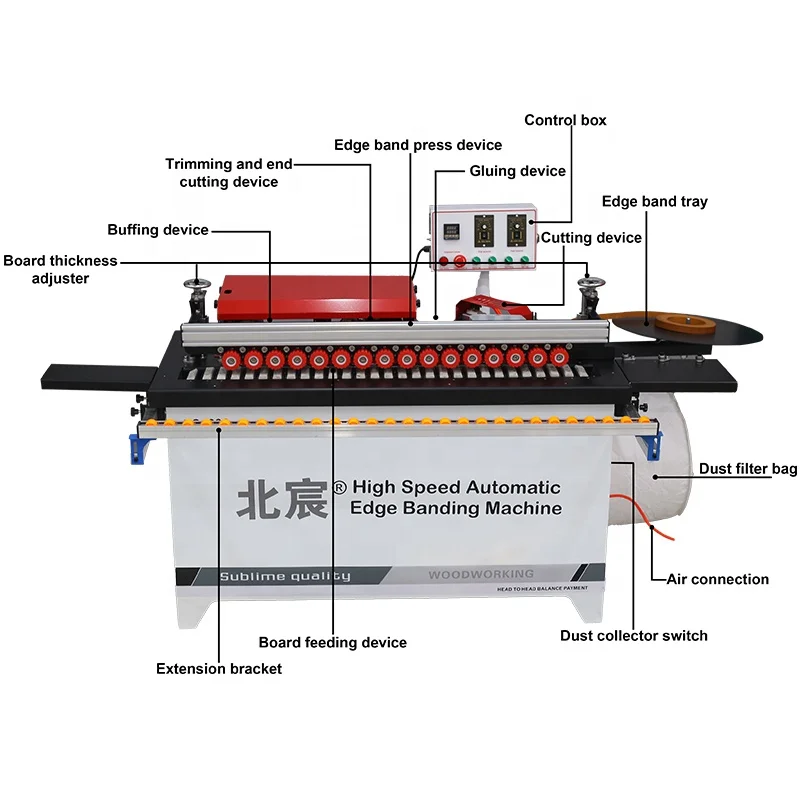
Edge banding machine
Click to enlarge
ISO 9001
CE Certified
OEM / ODM
12-Mo Warranty
Edge banding machine
DW802 Edge Banding Machine for MDF Particleboard Plywood | Technical Guide
<p><strong>DW802 Automatic Edge Banding Machine, 4200W, 0.3-3MM Banding Thickness</strong> — engineered for consistent edge sealing across MDF, particleboard, and plywood substrates in custom furniture production.</p> <ul> <li>Trimming and polishing stations deliver production-ready edge finish with automatic head and tail cutting, minimizing manual rework on mixed substrate batches.</li> <li>Glue pot capacity of 4000ml supports continuous operation, while integrated 1200W vacuum system ensures dust-free edge preparation for reliable adhesion.</li> <li>Minimum sheet dimensions of 25CM length and 10CM width accommodate small part processing common in cabinet and home decoration workflows.</li> </ul> <p>Engineer-led configuration recommendation with formal quotation within 24 hours ensures the machine matches your substrate mix and local voltage requirements.</p>
100+
Countries
MOQ 1
Unit
15-25 Days
Lead Time
0.3-3MM Edge Banding
Automatic Edge Banding Machine
Custom Furniture
DW802
MDF Particleboard Plywood
Process Application
Vacuum System
- Full OEM/ODM support -- custom logo, voltage (110V-440V), multilingual panels
- ISO 9001 & CE certified, 5 national patents, 60 professional engineers
- 12-month warranty, remote technical support & spare parts service
- Professional export packaging, customs clearance support, on-time delivery
Patented Mechanisms Verified — The DW802 automatic edge banding machine integrates a proprietary cutting mechanism achieving tight edge tolerances, validated through four-stage quality control before dispatch.
Technical Specifications
| Parameter | Value |
|---|---|
| Model | DW802 |
| Product Type | Automatic Edge Banding Machine |
| Total Power | 4200W |
| Voltage | 220V / 380V / customization available |
| Edge Banding Thickness Range | 0.3–3MM |
| Edge Banding Height Range | 0–50MM |
| Minimum Sheet Length | 25CM |
| Minimum Sheet Width | 10CM |
| Glue Pot Capacity | 4000ml |
| Trimming Power | 800W × 2 |
| Polishing Power | 180W × 2 |
| Vacuum Power | 1200W |
| Edge Power | 140W |
| Transmission Power | 140W |
| Air Source Pressure | 0.4–0.8MPa |
| Product Dimensions | 130 × 60 × 95CM |
| Product Weight | 135KG |
| Standard Functions | Edge banding, trimming, polishing, automatic head and tail cutting, vacuum hold-down |
| Control Language | Chinese and English standard; Spanish and other languages customizable |
| Plug Options | EU, USA, AU, UK |
| Certification | CE |
Application Suitability
| Application | Material or Output |
|---|---|
| Custom cabinet door edge sealing | MDF, particleboard with PVC or melamine edge band |
| Plywood furniture panel finishing | Plywood panels with veneer or ABS edge banding |
| Ecological board wardrobe production | Ecological board substrates, 0.3–3MM banding thickness |
| Small-batch home decoration panels | Solid wood boards and composite panels |
| Workshop-scale joinery output | Mixed substrate batches requiring consistent edge quality |
Why the Substrate Question Must Come Before the Quotation
Edge banding fails most often when the machine configuration ignores what the operator actually feeds into it.
I have watched factories pull a brand-new automatic edge banding machine off the crate, set the glue temperature to whatever the manual suggests, and wonder why PVC bands peel off particleboard by the second day. The problem was never the machine itself — it was that the glue application rate and trimming pressure were calibrated for MDF while the shop floor was running chipboard with an uneven surface profile [NEED_CITE: substrate density variation and glue adhesion behavior]. The DW802 automatic edge banding machine handles this gap because its adjustable trimming stations and controllable glue pot let production managers dial in settings for each substrate type rather than relying on a single default profile.
How Substrate Behavior Shapes Edge Quality
MDF cuts cleanly and accepts glue evenly, which makes it forgiving on most edge banders. Particleboard tells a different story — its porous surface absorbs glue faster, meaning the DW802’s 4000ml glue pot must run at a higher flow rate to maintain a consistent bond line across longer runs. Plywood introduces grain variation that can push thin veneer banding off track during the feeding stage, so the vacuum hold-down system becomes critical for keeping the panel steady through the trimming and polishing sequence.
Glue Temperature, Banding Material, and the Thickness Threshold
Running 0.3MM melamine through this machine at the same temperature used for 3MM PVC will scorch the thinner material and leave brittle edges. The DW802’s dual trimming motors at 800W each give enough cutting force for thick ABS bands, but the operator must reduce feed speed and lower the glue temperature when switching to thinner stock. I always recommend that buyers send their actual edge banding samples before finalizing the configuration [NEED_CITE: thermal behavior of PVC versus ABS edge banding adhesives]. A few degrees off on the glue pot can mean the difference between a bond that survives assembly and one that lifts during packaging.
Trimming and Polishing: Where Assembly Fit Gets Decided
The two polishing stations at 180W each remove residual glue squeeze-out and smooth the band-to-panel transition. If the trimming cutters leave even a slight ridge, the polishing wheels cannot compensate — they are finishing tools, not correction tools. On cabinet side panels where hardware mounts near the edge, an unfinished ridge from trimming can interfere with hinge plate seating downstream, which is why the automatic head and tail cutting function matters for maintaining dimensional consistency across every panel in a batch.
Reading the Specs That Actually Matter on the Floor
The 0.4–0.8MPa air pressure range controls the pneumatic cylinders that press the banding against the panel during the glue-setting phase. Running below 0.4MPa means weak contact pressure and visible glue lines; exceeding 0.8MPa risks crushing softer substrates like low-density particleboard. The minimum sheet dimensions — 25CM length and 10CM width — define the smallest offcut this automatic edge banding machine can process without jamming the feed chain. Workshops cutting drawer sides or narrow shelving brackets need to confirm their smallest part falls above these thresholds. Voltage customization between 220V and 380V matters because undersized circuits will trip under the 4200W total load during simultaneous trimming and polishing.
What Happens When the Configuration Misses the Mark
A workshop running 2MM ABS on a machine set up for 0.5MM melamine will find the trimming cutters struggling through excess material, leaving rough edges that require hand finishing. The polishing wheels then smear rather than buff, producing a hazy finish that customers reject on visible cabinet faces. Pneumatic pressure set too low on thin veneer causes the banding to drift during application, creating a misaligned edge that the automatic head and tail cutting cannot square up [NEED_CITE: common causes of edge band misalignment in panel processing]. These are not machine defects — they are configuration errors that compound through every downstream operation.
Why Production Managers Source This Configuration Here
In-house manufacturing means the DW802 is built and tested in one facility, so the engineer who configures the glue pot and trimming stations is the same team that runs pre-shipment verification. The four-stage quality control process covers incoming component inspection through to final dispatch, catching tolerance drift before the machine leaves Shandong. Voltage and plug customization is handled at the order stage rather than left as an aftermarket problem, and control panel language is set to match the operator who will actually run the equipment. Factory test records using the buyer’s own substrate and banding samples confirm edge quality before the crate is sealed.
Documentation & Verification
- CE declaration of conformity covering mechanical and electrical safety for this unit
- Machine specification sheet listing all DW802 power ratings and dimensional tolerances
- Electrical schematic confirming voltage, frequency, and plug type for your installation
- Factory test record showing edge sealing results on your supplied panel and banding samples
- Operation and maintenance manual in the agreed language covering glue temperature calibration
- Spare parts list identifying consumable cutters, polishing wheels, and pneumatic seals
Installation, Commissioning & Support
- 130 × 60 × 95CM footprint requires a level concrete floor with clearance on the infeed and outfeed sides
- 4200W total load demands a dedicated circuit matching the confirmed 220V or 380V supply at your facility
- 1200W vacuum system needs connection to a dust extraction line or standalone collector rated for fine MDF dust
- Air compressor must deliver stable 0.4–0.8MPa pressure with a regulator and moisture trap upstream of the machine
- First-run commissioning includes glue pot temperature profiling against your specific edge banding material and thickness
- Operator training covers feed speed adjustment, trimming depth setting, and daily polishing wheel inspection
What to Prepare Before Requesting a Quotation
Send the exact substrate types and thicknesses your line processes most frequently, along with the edge banding material and thickness you plan to run. Confirm your facility voltage, frequency, and available plug type so the electrical configuration is locked in before production. If you process parts smaller than standard panels, share the minimum dimensions so we can verify compatibility with the feed system.
Frequently Asked Questions
Q: How do I set glue temperature for different edge banding materials on this machine?
A: PVC typically requires a lower glue pot temperature than ABS, and melamine needs less heat than either. Start with the adhesive manufacturer’s recommended range, then run test pieces on your actual substrate. The DW802’s 4000ml glue pot holds temperature steadily during continuous runs, but you must adjust when switching between banding materials mid-shift to avoid scorching or weak adhesion.
Q: What edge banding thicknesses and materials does the 0.3–3MM range actually cover?
A: This range accommodates thin melamine and veneer strips at the lower end, through standard PVC and ABS bands in the middle, up to thick solid wood and high-impact ABS at the upper limit. The dual 800W trimming motors handle the full thickness span, but operators must reduce feed speed when processing bands above 2MM to maintain clean cuts.
Q: How do the trimming and polishing stations affect final edge quality?
A: The two trimming stations cut the banding flush with the panel surface and remove excess at the head and tail. The two 180W polishing stations then remove residual adhesive and smooth the transition. If trimming leaves ridges, polishing cannot correct them — both must be calibrated to the specific banding thickness for a production-ready finish.
Q: Can this machine handle small panels like drawer sides or narrow shelves?
A: The minimum processable sheet is 25CM long and 10CM wide. Parts below these dimensions risk jamming the feed chain or slipping past the vacuum hold-down during trimming. If your production includes components smaller than these thresholds, you will need a secondary method or a dedicated compact edge bander for those parts.
Q: What air pressure setup is needed for consistent edge feeding?
A: The machine requires 0.4–0.8MPa from a stable compressor with a regulator and moisture trap installed upstream. Pressure below 0.4MPa causes weak band-to-panel contact and visible glue lines, while pressure above 0.8MPa can damage softer substrates. Consistent pneumatic supply is essential for repeatable edge quality across long production runs.
Technical Specifications
| Parameter | Value |
|---|---|
| Product Name | DW802 Edge Banding Machine for MDF Particleboard Plywood | Technical Guide |
| Category | Edge banding machine |
| Voltage Options | 110V / 220V / 380V / 440V (customizable) |
| Frequency | 50Hz / 60Hz (customizable) |
| Certification | ISO 9001, CE |
| MOQ | 1 Unit |
| Lead Time | 15-25 Working Days |
| Warranty | 12 Months |
| OEM / ODM | Available -- logo, color, panel language |
* Detailed technical specifications vary by model. Please contact us with your specific requirements for a complete datasheet.
Shipping & Export
-
Export Packaging
Heavy-duty wooden crate with foam padding and moisture protection
-
Shipping Methods
Sea freight (FCL/LCL), air freight, express -- we support all methods
-
Customs Support
Full documentation: CO, commercial invoice, packing list, HS code assistance
-
Port of Loading
Tianjin / Qingdao port, China -- 20 years export experience
OEM / ODM Services
-
Logo & Branding
Custom logo printing, color scheme, and nameplate engraving
-
Voltage Configuration
110V / 220V / 380V / 440V, 50Hz / 60Hz -- any region supported
-
Multilingual Panels
Control panels in English, Spanish, French, Arabic and more
-
Custom Specifications
Modified dimensions, accessories, or feature sets on request
Get a Quote
Request Product Inquiry
Fill in your details and we'll respond within 24 hours with pricing and availability.
Direct Contact
How It Works
-
1
Confirm requirements & budget
Tell us your factory scale and processing needs
-
2
Receive recommendation & quote
We match the right machine with full specs
-
3
Negotiate & place order
OEM terms, voltage, payment and delivery
-
4
Production & QC inspection
Multi-stage quality control by 60 engineers
-
5
Export packaging & shipment
Professional packing, customs clearance
-
6
After-sales support
12-month warranty, remote tech support
You May Also Like